
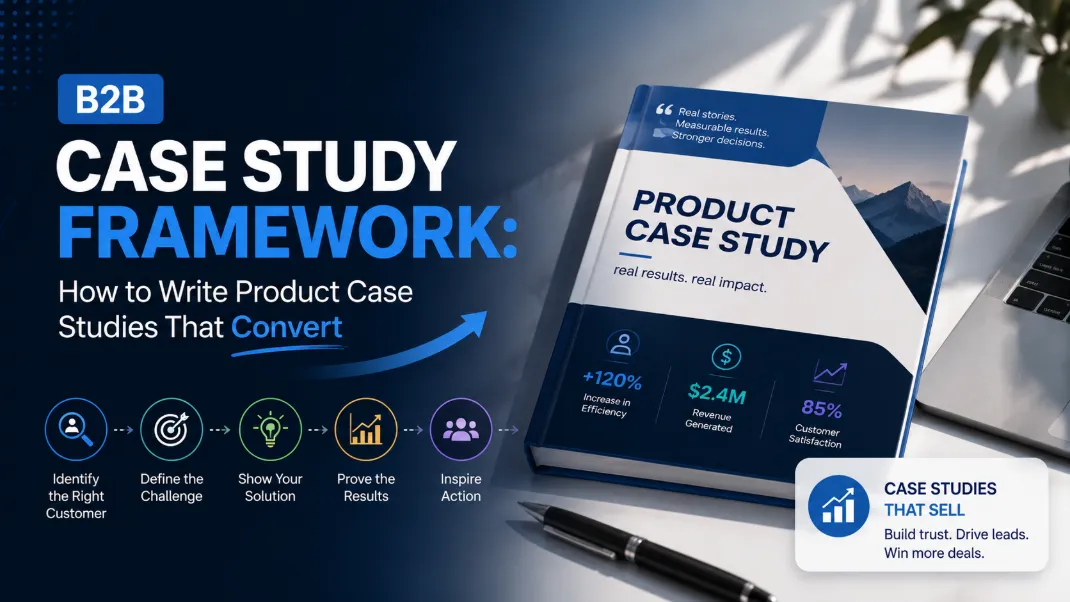
B2B Case Study Framework

Expert Byline
Sushmith Reddy
Release Date
Last Updated
How to Write Product Case Studies That Convert
I review hundreds of marketing websites every single year. And without fail, the most neglected, poorly written, and aggressively boring pages on any SaaS or agency website are the case studies.
Most companies treat their case studies like corporate brag sheets. They slap a company logo at the top, list three bullet points about how great their own software is, and throw in a generic quote from a CEO saying, "We love this product."
Nobody wants to read that. More importantly, nobody is going to spend $50,000 on your enterprise software because of that.
If you want to know how to write a case study that actually acts as a high-converting sales asset, you have to completely change your mental model. We are going to stop writing dry spec sheets. We are going to start writing psychological narratives.
I am going to show you exactly how to take the classical "Hero's Journey" narrative arc—the exact same structure used in Star Wars and The Matrix—and apply it to your marketing.
Grab a coffee. Let’s tear down the old way of doing things and build a B2B case study template that actually makes people want to buy what you sell.
Quick Navigation Map:
The Fatal Flaw of the Standard Case Study
Before we build the new framework, you need to understand why your current case studies are failing.
The fatal flaw is the protagonist.
Most companies position themselves as the hero of the story. They write the case study as if their software swooped in, saved the day, and rescued the helpless client.
This is incredibly arrogant. And from a psychological standpoint, it repels buyers. When a prospect reads your website, they want to picture themselves as the hero winning the day.
You are not Luke Skywalker. Your client is Luke Skywalker.
You are Yoda. You are the mentor. Your product is just the lightsaber. You exist to hand the hero a tool so they can go out, defeat the empire, and get all the glory.
Once you make this mindset shift, your writing instantly becomes magnetic.
The Hero's Journey: Your New B2B Case Study Template
Here is the exact framework you need to use. Stop using the old "Problem / Solution / Result" format. It is too brief and strips out all the human emotion.
Instead, we are going to walk the reader through a six-part narrative arc.
Phase 1: The Ordinary World (The Status Quo)
Do not start by talking about your product. Start by introducing the hero (your client) and the painful reality they were living in before they met you.
You need to describe their baseline friction. Make it visceral.
- Bad Example: "Acme Corp needed a better CRM."
- Good Example: "Acme Corp's sales team was spending 14 hours a week manually entering data into spreadsheets. Reps were burning out, leads were slipping through the cracks, and the VP of Sales had zero visibility into the quarterly pipeline."
When a prospect reads this, you want them to nod their head and say, "Wow, that is exactly what my Tuesday looks like."
Phase 2: The Breaking Point (The Inciting Incident)
A company can tolerate a bad workflow for years. So, what made them finally pull out a credit card? What was the catalyst?
Identify the breaking point. This is the moment the pain of staying the same finally became greater than the pain of changing.
- Did their servers crash on Black Friday?
- Did they lose a $100k client because of a missed email?
- Did a new CEO come in and demand a total system overhaul in 30 days?
Highlighting the breaking point creates massive urgency for the reader. It makes them realize they shouldn't wait for a disaster to hit before they fix their own broken systems.
Phase 3: Meeting the Mentor (The Search)
Your hero realizes they need help. Now, they go looking for a weapon.
This is where you introduce your product. But more importantly, this is where you explain why they chose you over your competitors.
Don't just say, "They found our software." Explain their evaluation process.
- "Acme Corp evaluated Salesforce and HubSpot, but they realized they didn't need a bloated enterprise tool. They needed something lightweight that their team could learn in 48 hours. That is why they booked a demo with us."
This subtly handles objections for the prospect reading the case study. You are proactively answering why you are better than the 800-pound gorilla in your industry.
Phase 4: Crossing the Threshold (The Implementation)
This is a massive secret weapon. Most case studies lie. They pretend that implementing a massive new software tool was completely effortless and flawless.
Nobody believes that. B2B buyers are smart. They know that migrating databases or onboarding 50 employees is a nightmare.
Show a little friction. Talk about a specific hurdle you hit during implementation, and then explain exactly how your customer support team stepped in to solve it.
Showing how you handle problems builds infinitely more trust than pretending problems don't exist. It proves you won't abandon them after the check clears.
Phase 5: The Climax (The Hard ROI)
This is the payoff. The hero uses the lightsaber and wins the battle.
This is where you drop the heavy, undeniable metrics. But you must tie the data directly back to the pain you established in Phase 1.
- Don't just write: "We increased efficiency by 20%."
- Write: "Because the CRM automated all manual data entry, those sales reps got their 14 hours a week back. In month three, Acme Corp saw a 22% increase in outbound calls and closed $450,000 in net-new revenue."
Give exact numbers. Use percentages, dollar amounts, and hours saved. Hard data validates the emotional story you just told.
Phase 6: The Return (The New Normal)
End the story by showing what the hero's life looks like now.
How has their day-to-day changed? Did the VP of Sales get promoted? Is the marketing team finally leaving the office at 5:00 PM instead of working weekends?
Give the hero the glory. Quote them talking about how much better their team is performing. This leaves the reader deeply craving that exact same transformation.
The Extraction Process: Asking the Right Questions
You cannot write a brilliant narrative if you conduct a terrible interview.
If you just email a client and ask, "Did you like our product?", they will reply, "Yes, it was great." That is useless. You have to extract the story.
Get them on a 20-minute Zoom call. Record it. Ask these exact questions to build your narrative:
- "Take me back to six months ago. What was the most frustrating part of your week before we started working together?" (Extracts Phase 1)
- "What was the specific trigger that made you realize you couldn't delay fixing this anymore?" (Extracts Phase 2)
- "I know you looked at
- $$Competitor Name$$
- . Why did you specifically decide to go with us?" (Extracts Phase 3)
- "What surprised you the most about the onboarding process?" (Extracts Phase 4)
- "If you were pitching this product to a colleague at another company, what single metric or result would you point to?" (Extracts Phase 5)
Designing for the Scanner
Even if you write a Pulitzer-worthy case study, a B2B buyer is not going to read every single word. They are going to scan it. Your design has to carry the weight of the story.
If you hand them a wall of text, they will bounce. You must optimize the formatting.
1. The 3-Part Headline
Never title your page "Acme Corp Case Study." That is a waste of prime real estate.
Use this formula:
$$Action Taken$$
+
$$Hard Metric$$
+
$$Client Name$$
- Example: "How We Cut Churn by 40% in 60 Days for Acme Corp"
2. The Executive Summary Box
At the very top of the page, put a dark, contrasting box. Inside it, put three bullet points summarizing the entire story (The Problem, The Solution, The Hard ROI). If a busy CEO only reads this box, they should get the entire value prop.
3. Massive Pull Quotes
When your client says something highly emotional or impactful during the interview, isolate it. Blow the text up. Make it bold. Use it as a visual break between your paragraphs.
The Universal Copy-and-Paste Master Template
If you are staring at a blank screen wondering how to organize all this, stop overthinking. Use this exact structural outline. It works for SaaS products, digital marketing agencies, consultants, and enterprise hardware.
Copy and paste this directly into your Google Doc:
$$Headline$$
: How
$$Your Company$$
helped
$$Client Name$$
achieve
$$Specific Hard Metric$$
in
$$Timeframe$$
The Executive Summary
- The Challenge:
- $$1-sentence summary of their painful status quo$$
- The Solution:
- $$1-sentence summary of what you implemented$$
- The Results:
- $$3 bullet points of hard, undeniable data/metrics$$
Part 1: The Nightmare Before (The Status Quo)
- Introduce the client and what they do.
- Detail the specific, painful process they were using before they met you.
- Highlight the human cost (wasted time, frustration, lost revenue).
- Insert Quote: Client complaining about the old way of doing things.
Part 2: The Catalyst (The Inciting Incident)
- What specific event forced them to finally seek out a solution? (A crashed server, a lost deal, a new CEO mandate).
- Emphasize the urgency. They could no longer wait.
Part 3: The Search & The Choice (Meeting the Mentor)
- Briefly mention their evaluation process.
- Why did they choose you over the bigger, older competitors in your space? (Price, customer service, specific feature).
- Insert Quote: Client explaining why your brand stood out to them.
Part 4: The Build (The Implementation)
- Describe the onboarding or setup process.
- Be honest: Mention one minor hurdle or friction point you hit early on, and explain exactly how your customer success team solved it. (This builds massive trust).
Part 5: The Results (The Hard ROI)
- The payoff. Detail the exact metrics achieved.
- Tie the metrics directly back to the pain points mentioned in Part 1.
- Use bold text for percentages, dollar amounts, and hours saved.
Part 6: The Aftermath (The New Normal)
- What does the client's day-to-day look like now?
- Give the hero the glory. Show how their team is winning, relaxed, and dominating their industry.
- Insert Quote: Client summarizing their overall satisfaction and recommending your product.
$$Call to Action Button$$
: "Want these same results for your team? Book a demo today."
The Final Polish
Writing product case studies that actually work isn't about bragging. It is about empathy.
It is about proving to a terrified, hesitant buyer that you deeply understand their specific nightmare, and that you have successfully guided someone else out of that exact same nightmare.
Stop treating your client success stories as an afterthought. Build your B2B case study template around the Hero's Journey. Interview for emotion. Highlight the hard data. Position your client as the champion, and watch your conversion rates change overnight.