
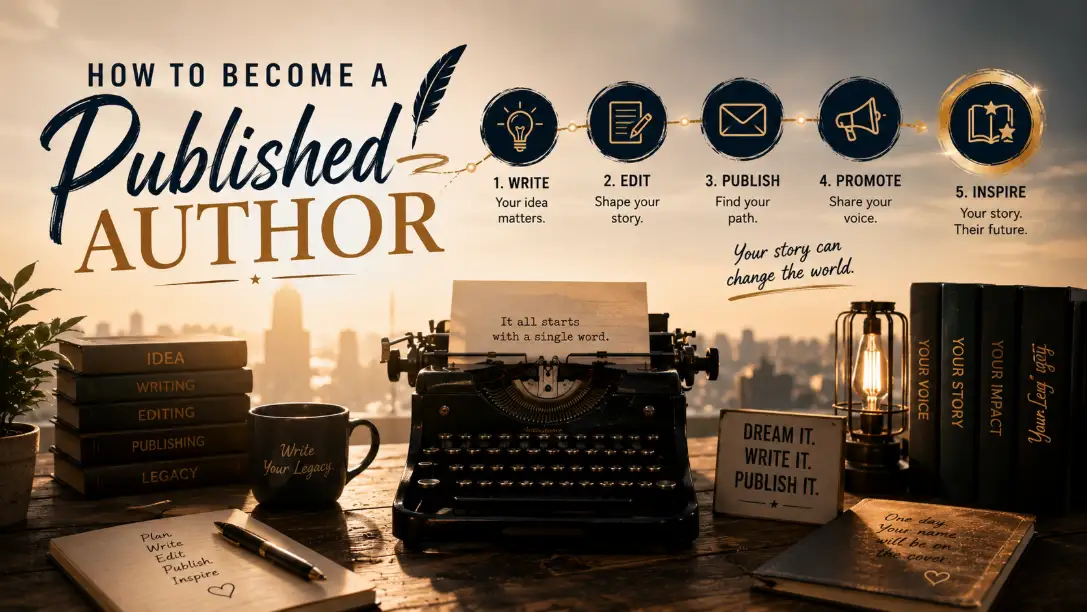
How to Become a Published Author?

Expert Byline
Sushmith Reddy
Release Date
Last Updated
A Complete Guide to Publishing Your First Book
Imagine how cool it would be if you had the term "published author" on your resume? That is how I got my first job. They loved my book. They knew I could be the right writer for their team. I was hired instantly.
Having your name on the cover of a real, physical book is the ultimate credibility booster. It completely changes how people look at you in a meeting, at a networking event, or in an interview.
But if you are sitting there with a finished manuscript (or just a really good idea) staring at Google and trying to figure out how to actually publish a book, you are probably drowning in conflicting advice. Half the internet tells you to find a literary agent. The other half tells you to self-publish on Amazon immediately.
Let's cut through the noise.
There is no "one size fits all" way to become an author anymore. The publishing industry has fractured into several massive, highly profitable paths. I am going to walk you through every single legitimate way to publish a book today, step-by-step, with absolutely nothing held back.
Grab a coffee. We are going to look at the exact mechanics of traditional publishing, self-publishing, hybrid models, and web serialization.
Quick Navigation Map:
The Prerequisites (Before You Publish)
Before we talk about agents or Amazon, we have to talk about the product. You cannot publish a first draft.
The biggest mistake new writers make is rushing to market before the book is actually ready. If your core plot is broken, no amount of marketing will save it. You need to make sure you have strictly followed the laws of story writing to build a solid foundation.
Once the first draft is done, you have to edit.
If you are writing a novel, you need to ruthlessly check your pacing and character arcs against the rules of storytelling. If you are writing a memoir or a personal narrative, you have to ensure you are extracting a universal lesson from your life, not just trauma-dumping on the page.
Once your manuscript is as clean, polished, and structurally sound as you can possibly make it, you are ready to choose your publishing path.
Traditional Publishing
This is the old-school path. You write the book, you find an agent, the agent sells it to a major publisher (like Penguin Random House or HarperCollins), and they pay you for the right to print it.
You do not pay a single dime to publish this way. Money always flows to the author.
Step 1: Writing the Query Letter
You cannot just email a publisher directly. You need a literary agent. To get an agent, you have to write a "query letter." This is a one-page pitch that includes:
- The Hook: A one-sentence summary of your book.
- The Blurb: Two short paragraphs explaining the main character, the conflict, and the stakes (similar to the back cover of a book).
- Your Bio: A short paragraph about who you are, linking out to your portfolio or mentioning what types of writers you relate to.
- Comps: Two recently published books that are similar to yours to prove there is a market for it.
Step 2: The Submission Trenches
You will use databases like QueryTracker to find agents who represent your specific genre. You will send your query letter and the first 10 pages of your manuscript to dozens of agents. Expect rejection. It is entirely normal to get 50 "no"s before you get a "yes."
Step 3: The Book Deal and Advance
If an agent offers you representation, they will help you polish the manuscript and then pitch it to editors at major publishing houses. If a publisher buys it, they will offer you an "advance against royalties." This is a lump sum of money paid up front. You won't earn any more money until your book sales earn back that initial advance.
Step 4: The Waiting Game
Traditional publishing moves incredibly slow. From the day you sign your book contract to the day the book actually hits the shelves at Barnes & Noble, you will usually wait 18 to 24 months. During this time, the publisher handles the cover design, professional editing, and distribution.
Self-Publishing / Indie Author
If you hate waiting for permission and want total creative control, welcome to the world of indie publishing.
Self-publishing used to have a terrible reputation. Today, it is a multi-billion dollar industry where savvy authors regularly make six-figure incomes. You own 100% of the rights and keep up to 70% of the royalties. But you are also acting as the publisher, which means you have to pay the upfront costs to produce a professional product.
Step 1: Hiring Professional Editors
You cannot skip this. You need to hire a freelance editor. Usually, indie authors hire two:
- A Developmental Editor: They look at the big picture (plot holes, pacing, character arcs).
- A Copyeditor / Proofreader: They fix the grammar, typos, and awkward phrasing.
Step 2: Professional Cover Design
Do not design your own cover in Canva unless you are a professional graphic designer. Readers absolutely judge a book by its cover. You will hire a designer (on sites like Reedsy or 99designs) to create a cover that perfectly matches the visual expectations of your specific genre.
Step 3: Formatting the Interior
Your Word document has to be converted into a clean ePub file for e-readers and a PDF for print. Most indie authors use software like Vellum (for Mac) or Atticus (for PC) to automatically format beautiful chapter headings and drop caps with a single click.
Step 4: Uploading to Distributors
You do not need a printing press. You will use Print-on-Demand (POD) technology.
- Amazon KDP (Kindle Direct Publishing): You upload your formatted files and cover here. When a customer buys the physical book, Amazon prints one single copy and ships it. You never have to hold inventory in your garage.
- IngramSpark / Draft2Digital: You upload here to get your book distributed to Apple Books, Kobo, Barnes & Noble online, and local libraries.
Step 5: Marketing and Ads
Because you don't have a publisher's marketing team, you have to drive traffic yourself. Successful indie authors heavily utilize Amazon Ads, build massive email newsletters, and send free early copies (ARCs) to readers on TikTok and Instagram to generate reviews before launch day.
Hybrid Publishing
Hybrid publishing sits exactly between traditional and self-publishing.
In this model, you partner with an independent publishing house. You pay them a heavily subsidized upfront fee to cover the production costs (editing, cover design, formatting), but in exchange, they handle all the heavy lifting and you split the royalties (usually 50/50).
The Big Red Flag: Avoiding Vanity Presses
You have to be incredibly careful here. The internet is full of scam companies called "vanity presses." A vanity press will charge you $10,000, print a terrible version of your book, do zero marketing, and then disappear.
How to Spot a Legit Hybrid Publisher
A real, ethical hybrid publisher does not accept every book submitted to them. They curate. They have strict quality standards because their business model relies on actually selling books, not just taking upfront fees from authors. If a company praises your manuscript but immediately asks for thousands of dollars without clearly explaining their distribution channels, run away.
Serialized & Web Publishing
What if you don't want to write a 300-page book in secret? What if you want to publish chapter-by-chapter and build a fanbase in real-time?
Serialized publishing is how Andy Weir originally published The Martian. He posted it chapter by chapter on his blog before it became a massive movie. Today, this is one of the fastest-growing sectors in the writing world.
Step 1: Choosing a Platform
You write a chapter a week and upload it directly to readers on platforms built for serialization:
- Substack: Incredible for non-fiction writers, essayists, and serialized memoirs. You can build a free email list and eventually charge readers a monthly subscription to read premium posts.
- Kindle Vella / Radish: Highly optimized for romance, fantasy, and thriller fiction. Readers buy "tokens" or "coins" to unlock your chapters one by one.
- Wattpad / Royal Road: Massive, free communities where millions of younger readers consume fanfiction, Sci-Fi, and LitRPG stories.
Step 2: The Feedback Loop
The greatest benefit of web publishing is the immediate feedback. You post a chapter on Tuesday, and by Wednesday morning, you have fifty comments telling you exactly what the readers loved or hated. You can adjust your plot in real-time based on audience reactions.
Step 3: Monetization via Patreon
Many web fiction authors give their chapters away for free on Royal Road or Wattpad to build a massive audience. Then, they set up a Patreon. Super-fans will gladly pay $5 or $10 a month to read chapters two weeks earlier than the public. Highly successful web authors make tens of thousands of dollars a month just through Patreon subscriptions.
The Verdict: Which Path Should You Choose?
Stop staring at the blank page wondering what kind of author you are supposed to be.
- If you want the prestige of seeing your book in a physical bookstore, have extreme patience, and don't want to spend your own money, start querying agents for Traditional Publishing.
- If you want to keep all the profits, want your book out in the world this year, and treat writing like a small business, dive into Self-Publishing on Amazon.
- If you love instant gratification, want to build a community, and write fast, start posting chapters on Substack or Royal Road.
The world doesn't care which button you pressed to publish the book. They only care about the words on the page. Pick the path that fits your budget and your personality, sit down at the keyboard, and get to work.