
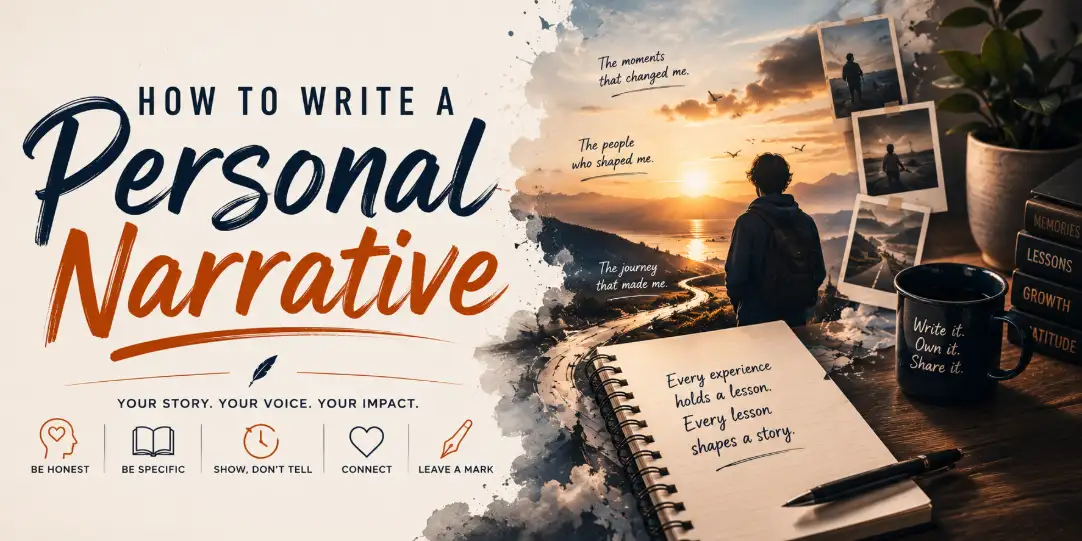
The Anatomy of a Perfect Personal Narrative (Plus Powerful Examples)

Expert Byline
Sushmith Reddy
Release Date
July 14, 2026
I read a lot of submission piles, and I can tell you exactly when a writer loses me. It usually happens in the first three paragraphs. Most writers assume a personal narrative is just a diary entry with better adjectives. They sit down, start at the day they were born, and treat their life like a chronological police report.
That isn't storytelling. That’s just typing.
A true personal narrative is a highly engineered piece of empathy. It takes a messy, chaotic real-life event and structures it so tightly that a total stranger feels like it happened to them.
If you look at the best personal narrative essays out there, you’ll notice they don’t just rely on having an incredibly dramatic life. The authors rely on structure, pacing, and ruthless self-awareness. Let’s grab a coffee and break down exactly why the greats succeed, and how you can steal their architecture to write your own.
Quick Navigation Map:
3 Core Pillars of a Personal Narrative
Before we look at the examples, we need to understand the machinery underneath them. Every piece of compelling creative nonfiction stands on three specific pillars.
1. The Universal Truth Hidden in a Micro-Moment
Amateurs think they need to write about the day the world ended to get someone's attention. Professionals know that the most devastating stories happen in the quiet moments. You don't write about the entirety of a ten-year bad marriage; you write about the Tuesday afternoon you realized you were both fighting over how to load the dishwasher, and what that actually meant. The micro-moment is the entry point to the universal human experience.
2. The Double-Perspective (The "Now" vs. The "Then")
This is the secret weapon of the personal essay structure. You aren't just one person in the story; you are two. There is the "Then" Character—the version of you who lived through the event, making mistakes and feeling confused. And there is the "Now" Narrator—the older, wiser version of you who is telling the story, providing reflective storytelling and context. The tension between who you were and who you are now is what drives the narrative arc.
3. Vulnerability Without Self-Indulgence
If you are the flawless hero of your own personal narrative, I am going to stop reading. A good story requires flaws. But there is a trap here: don't confuse vulnerability with an unedited trauma dump. You have to process the emotion before you publish it. We want to see your scars, but you need to show us how you got them with objective clarity.
Analysing the Best Personal Narrative: Examples
Instead of just listing a bunch of famous essays and telling you they are good, let's reverse-engineer them. We are going to look at the exact mechanics these authors used to hook the reader and stick the landing.
Category 1: The "Coming-of-Age" & Disillusionment Narrative
Example: Goodbye to All That by Joan Didion
This is the undisputed heavyweight champion of the "moving to New York" essay. Didion writes about her time as a young writer in the city, but it's really an autopsy of youthful delusion.
- The Hook: She opens by admitting she can't remember when she first realized she didn't want to live in New York anymore. It immediately establishes a melancholic, reflective tone.
- The Arc: We watch the "Then" Character (young Didion) fall in love with the sheer chaos of the city. But the "Now" Narrator slowly drip-feeds the reality of burnout. The pacing is a slow, beautiful deterioration.
- The Takeaway: You don't have to end on a triumph. Didion leaves New York feeling numb. The essay works because it captures the exact moment you realize you can never go back to being naive.
Category 2: The "Micro-Moment" Shift in Perspective
Example: The Crane Wife by CJ Hauser
Hauser goes on a scientific expedition to study whooping cranes ten days after calling off her wedding.
- The Hook: She starts in media res (in the middle of the action) on the expedition, dealing with physical discomfort, before brutally pivoting to the realization that she almost married the wrong man.
- The Arc: The essay brilliantly alternates between two timelines. She balances "The Scene" (the physical reality of tracking birds in the mud) with "The Reflection" (analyzing why she kept making herself small for her ex-fiancé).
- The Takeaway: The cranes become the perfect metaphor for her own need to be seen and cared for. She takes a highly specific, strange event and extracts a universal truth about romantic compromise.
Category 3: Reframing Trauma with Humor
Example: Why I Hate Mother’s Day by Anne Lamott
Lamott takes a universally beloved holiday and completely dismantles it, using her trademark dark humor to discuss grief, expectations, and the reality of parenting.
- The Hook: The title itself is a provocation. It immediately makes the reader ask, "Wait, why?" She hooks you with friction.
- The Arc: She doesn't just complain. She uses sensory details and highly specific family anecdotes to show the immense, suffocating pressure of performing "perfect motherhood."
- The Takeaway: Humor is just tragedy separated by time and space. Lamott uses jokes as a defense mechanism, slowly dropping her guard to reveal the raw grief underneath.
How to Write Connecting Personal Narratives?
You’ve seen how the pros do it. Now, how do you start staring at a blank page and actually build one of these things? Here is your step-by-step framework.
Step 1: Find Your "Inciting Incident" in the Ordinary
Don't brainstorm "themes." Brainstorm moments. Look for the friction in your life. What was the exact second a belief you held was shattered? What was the moment you realized your parents were just flawed humans? That specific, localized second is your inciting incident. That is where the story starts.
Step 2: The "In Media Res" Opening
Never start with "I was born in Ohio..." or "The year was 2014." Drop us directly into the fire. Start mid-conversation. Start in the middle of a panic attack. Start while you are running to catch a train you are definitely going to miss. Give the reader action first, and feed them the necessary background context later.
Step 3: Pacing the Emotional Arc (Showing vs. Telling)
You’ve heard "show, don't tell" a million times, but here is what it actually means in creative nonfiction:
- Telling: "I was terrified of my boss." (Boring. Delete it.)
- Showing: "I kept my hands shoved deep in my pockets so she wouldn't see the paperclip I had bent out of shape out of sheer anxiety."
Ground your emotions in physical reality. Use the five senses. If you are sad, what does the room smell like? If you are angry, what is the exact texture of the steering wheel you are gripping?
Step 4: Forging the "Echo Ending"
The conclusion of a good personal narrative shouldn't just summarize what you already said. It needs to echo the beginning, but show the permanent transformation. If you started the essay staring out a window feeling trapped, end it by opening that exact same window to let the air in. Prove to the reader that the journey actually changed your baseline chemistry.
3 Traps We all Fall Into (And How to Fix Them)
I see these three bugs in rough drafts constantly. Catch them before you hit publish.
Trap 1: The "And Then" Timeline
If your story goes, "This happened, and then this happened, and then I went home," you don't have a plot. You have a schedule. A narrative arc requires causality. It should be, "This happened, therefore this happened, but this got in the way." Every scene must trigger the next.
Trap 2: Skipping the "Reflective" Insight
You can write the most beautifully descriptive scene about a car crash, but if you don't step back and tell the reader why it matters to your internal growth, it falls flat. You need that "Now" Narrator to step in and say, "Looking back, I realize that wasn't just a physical collision; it was the moment I realized I wasn't invincible."
Trap 3: Preaching the Moral
Don't end your essay with a neat little bow, lecturing the reader on what they should learn. It feels incredibly condescending. Let the messiness of the story speak for itself. Trust that if you built the emotional arc correctly, the reader will understand the lesson without you having to spell it out in neon lights.
Frequently Asked Questions
What is the exact difference between a personal narrative and a memoir?
Scope and length. A memoir is a book-length exploration of a specific period or theme in your life (usually 60,000+ words). A personal narrative is a short, highly focused essay (typically 1,000 to 3,000 words) centering on a single event or a very tight timeline.
How long should a personal narrative be?
Exactly as long as it takes to tell the story and land the emotional punch. Generally, if you are pitching to literary magazines or blogs, aim for 1,200 to 2,500 words. Any shorter, and you probably lack reflective depth. Any longer, and you are likely rambling.
Can a personal narrative include dialogue?
Absolutely. In fact, it should. Dialogue breaks up heavy blocks of text, reveals character intent instantly, and forces you to show rather than tell. Just remember, you don't need to transcribe real life exactly word-for-word. Condense the dialogue to capture the essence and the friction of the conversation.