
From Web Serial to Bestseller: Case Studies in Digital Publishing (2026 Edition)

Expert Byline
Sushmith Reddy
Release Date
Last Updated
For decades, the publishing industry operated under a strict, unyielding assumption: if you gave your writing away for free on the internet, you were ruining your chances of ever becoming a "real" author. Literary agents would reject you instantly if they found out your manuscript was already posted on a blog.
That assumption is now entirely dead.
In 2026, the traditional publishing industry isn't ignoring web serials; they are actively hunting them. The gatekeepers have realized that platforms like Royal Road, Wattpad, and personal blogs are not just amateur sandboxes—they are massive, data-driven proving grounds.
If you can build an audience of 50,000 rabid fans on a free platform, traditional publishers will happily pay you a six-figure advance to print a physical copy of the exact same story.
Grab a coffee. We are going to look at the exact career blueprints of authors who started by posting free chapters online and ended up with massive traditional book deals, Netflix adaptations, and multi-million dollar franchises. We are going to break down why they succeeded, and how you can replicate their strategy.
Quick Navigation Map:
Case Study 1: The Personal Blog Phenomenon (Andy Weir)
Andy Weir is the ultimate patron saint of the rejected author.
Before The Martian became a Ridley Scott movie starring Matt Damon, Andy Weir was a software engineer in California who had already tried the traditional publishing route and failed miserably. He spent three years writing full-time, collected a massive pile of form rejections from literary agents, and eventually went back to programming, assuming the publishing world just didn't want him.
The Strategy: Writing for the Core Niche
In 2009, Weir started writing a new novel about an astronaut stranded on Mars. But this time, he didn't query a single agent. He just posted the chapters for free on his personal website as he finished them.
Weir had spent the last decade building a small mailing list of about 3,000 readers who followed his webcomics and short stories. He knew exactly who these people were: hardcore, nit-picky science geeks.
He wrote The Martian specifically for them. He included massive amounts of orbital mechanics and complex math equations. He didn't try to appeal to a mainstream audience.
The Turning Point: The 99-Cent Amazon Hack
As the serial grew, Weir's readers complained that reading long chapters on a computer monitor was annoying. They asked him to make a Kindle version.
Weir formatted the book and uploaded it to Amazon KDP. He wanted to make it free, but Amazon's system forced a minimum price of $0.99.
He hit publish. Within three months, that $0.99 eBook sold 35,000 copies, rocketing to the top of Amazon's sci-fi charts. Suddenly, the traditional publishers who had rejected him years earlier came knocking. Crown Publishing bought the print rights for a massive six-figure deal, and 20th Century Fox bought the movie rights.
The Takeaway: You do not need to appeal to everyone. If you write hyper-specific, highly technical fiction for a deeply engaged niche, they will become your ultimate marketing engine.
Case Study 2: The Royal Road LitRPG Empire (Matt Dinniman)
If you want to understand how the web serial economy works in 2026, you have to look at the LitRPG (Literary Role-Playing Game) genre, and specifically, you have to look at Matt Dinniman’s Dungeon Crawler Carl.
Dinniman was working the convention circuit, drawing pet portraits, and self-publishing horror books with moderate success. In 2019, he started posting chapters of a new story on Royal Road, a platform famous for progression fantasy and LitRPG.
The Strategy: The Royal Road to Patreon Pipeline
Dungeon Crawler Carl is utterly bizarre. It follows a man and his ex-girlfriend's prize-winning Persian cat (Princess Donut) as they are forced to survive an intergalactic, televised dungeon crawl after aliens destroy Earth.
It was wildly original, darkly comedic, and perfectly suited for Royal Road's audience, which craves stat screens, leveling up, and high-stakes action.
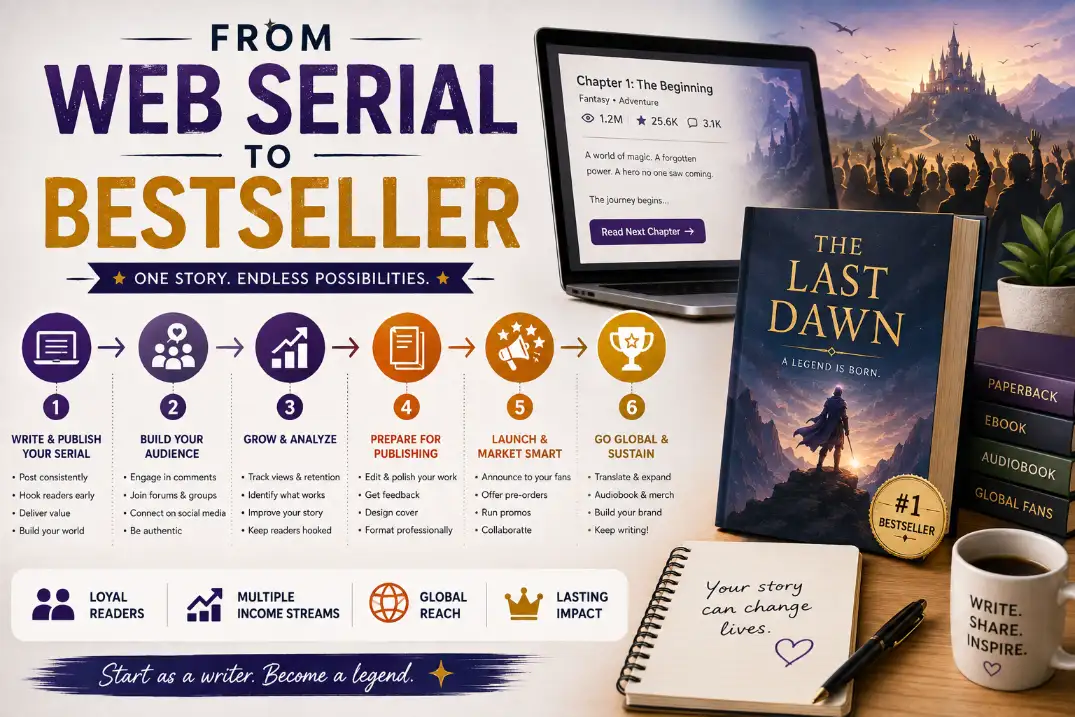
Dinniman utilized the classic web serial pipeline:
- Free Visibility: Post chapters for free on Royal Road to build a massive follower count and hit the "Trending" lists.
- Patreon Monetization: Offer advanced chapters on Patreon for superfans who can't wait for the next free update.
- Amazon Packaging: Take the completed "arcs" or "books" off Royal Road, polish them, and self-publish them on Amazon Kindle and Audible.
The Turning Point: Audiobooks and Traditional Acquistion
The series exploded on Amazon, but the true catalyst was the audiobook. Narrated by Jeff Hays, the audio version of Dungeon Crawler Carl became a viral sensation in the sci-fi community.
Dinniman was making massive money entirely independently. He didn't need a publisher.
But traditional publishing needed him. Because the series was generating millions of dollars in revenue, Penguin Random House (via their Ace Books imprint) stepped in and offered a massive deal to acquire the print rights to the series. Dinniman was smart—he kept his highly lucrative eBook and audiobook rights, allowing a massive corporation to handle only the physical bookstore distribution.
Today, the series has sold over ten million copies and is being adapted for television by Seth MacFarlane’s production company.
The Takeaway: Royal Road is a testing ground. If you can build a rabid following there, you have all the leverage. You don't have to sell all your rights to a traditional publisher; you can negotiate deals that only benefit you where you are weak (like physical bookstore distribution).
Case Study 3: The "Cozy Fantasy" Explosion (Travis Baldree)
Sometimes, web serial success isn't about writing a 20-book epic. Sometimes, it is about creating a hyper-specific, comforting vibe.
Travis Baldree was already highly successful in the publishing world, but not as an author. He was an incredibly popular audiobook narrator. But during NaNoWriMo (National Novel Writing Month), he decided to write his own book.
The Strategy: Defying the Genre Expectations
He wrote Legends & Lattes. The premise was incredibly simple: An orc barbarian retires from a life of bloody adventuring to open the first-ever coffee shop in a fantasy city.
It was "high fantasy, low stakes." There was no world-ending threat. It was just about making good pastries and finding a found family.
Baldree self-published the book.
The Turning Point: BookTok and The Traditional Pivot
The book caught fire on BookTok (the reader community on TikTok). Readers who were exhausted by grimdark fantasy and real-world stress flocked to the book because it felt like a "warm hug." It became an instant indie bestseller.
Seeing the massive, organic social media traction, Tor Books (an imprint of Macmillan) stepped in and offered to traditionally publish the book and its prequel.
Because Baldree had already proven the market demand, Tor threw massive marketing weight behind it, securing special stenciled-edge hardcover editions and pushing it onto the New York Times Bestseller list.
The Takeaway: If you write a book that taps into a specific, unfulfilled emotional need in the market (in this case, "cozy fantasy"), self-publishing allows you to prove the concept fast. Once the concept is proven, traditional publishers will pay a premium to scale it.
Case Study 4: The Wattpad Hollywood Pipeline (Anna Todd)
Wattpad operates on entirely different demographics than Royal Road. It is heavily skewed toward younger demographics, romance, and fanfiction. But the financial ceiling is just as high, if not higher, because Wattpad is directly tied to Hollywood.
The Strategy: Riding the Fanfiction Wave
Anna Todd started writing on Wattpad on her phone. She wrote After, a fanfiction story heavily inspired by the boy band One Direction (specifically Harry Styles, who served as the visual inspiration for the bad-boy love interest, Hardin).
She wrote obsessively, posting short, cliffhanger-heavy chapters almost every single day. She engaged constantly with her readers in the comments.
The Turning Point: From Phone Screen to Silver Screen
The engagement numbers became astronomical. After accumulated over a billion reads on Wattpad.
Traditional publishing could not ignore metrics like that. Simon & Schuster acquired the rights, polished the serial into a multi-book series, and released it globally.
But Wattpad’s true power is its internal studio division. Wattpad actively pitches its most successful stories to film and television executives. After was adapted into a massive, multi-film franchise.
Other Wattpad stories, like The Kissing Booth (Beth Reekles) and My Life With the Walter Boys (Ali Novak), followed the exact same pipeline: write on Wattpad, build millions of reads, get a traditional book deal, and get adapted by Netflix.
The Takeaway: Wattpad is driven by velocity and community. If you can write addictive, trope-heavy romance and engage with your readers daily, you aren't just writing a book; you are auditioning for a streaming service.
The Bottom Line: The Data-Driven Pitch
What do Andy Weir, Matt Dinniman, Travis Baldree, and Anna Todd all have in common?
They didn't ask a gatekeeper for permission. They didn't spend two years querying literary agents, hoping someone would guess that their book might be profitable.
They bypassed the gatekeepers, went directly to the readers, and built the audience themselves.
In 2026, the most powerful query letter you can send to a literary agent or a publisher is not a beautiful description of your plot. It is a link to your Royal Road or Wattpad page showing them that 50,000 people are already reading your story every single week.
The internet is no longer the place where rejected authors go to hide. It is the incubator where the next massive, multi-million dollar franchises are built. Give your words away for free, prove the market, and let the publishers come to you.