
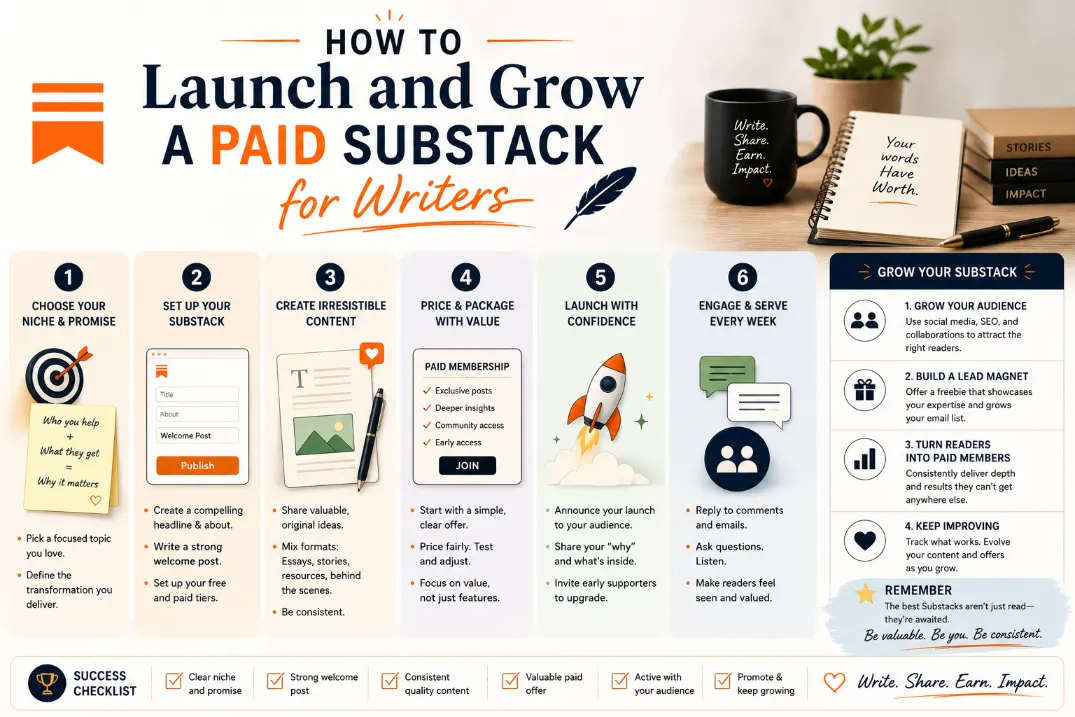
How to Launch and Grow a Paid Substack for Writers (The 2026 Master Guide)

Expert Byline
Sushmith Reddy
Release Date
Last Updated
Let’s establish the most important rule of the newsletter economy right now.
You cannot out-optimize a small numerator.
Every day, I see writers panic about their paid Substack strategy. They agonize over pricing. They debate whether to charge $5 or $8 a month. They rewrite their welcome email fifteen times.
But when I ask them how many people are on their free list, they say, "150."
In 2026, a healthy, optimized Substack converts anywhere from 2% to 10% of its free list into paying subscribers. If you have 150 free readers, a 5% conversion rate means you have 7 paid subscribers. That is $35 a month. You are not going to quit your day job on $35 a month.
If you want to build a six-figure newsletter, you have to master two completely distinct skill sets: Growth (building the massive free audience) and Monetization (giving them a highly specific reason to open their wallets).
Grab a coffee. We are going to look at the exact math, the psychological triggers that convert free readers to paid, and the brutal reality of how long it actually takes to build a paid empire on Substack.
Quick Navigation Map:
Phase 1: The Growth Engine (Filling the Funnel)
Before you ever ask someone for money, you have to build the audience. Substack is incredibly powerful because it is not just an email sender (like Mailchimp); it is a discovery network.
Here is exactly how you feed the machine in 2026.
1. The Recommendations Feature (Your Golden Goose)
Currently, up to 40% of all new Substack subscriptions come directly from the internal network. When someone subscribes to a newsletter, Substack suggests three other newsletters they might like.
You need to be one of those suggestions.
- The Tactic: Do not wait for people to randomly recommend you. Find 10 to 15 newsletters in your exact niche that have roughly the same subscriber count as you. Subscribe to them. Read their work. Then, send a polite, direct email proposing a "Recommendation Swap." You recommend them, they recommend you. As you grow, continually prune this list and partner with larger publications.
2. Substack Notes (The Top of the Funnel)
Notes is Substack’s internal version of Twitter/X. It is where you capture readers who have never heard of you.
- The Tactic: Do not just drop a link to your latest post and run away. Treat Notes like a micro-blog. Pull the single most controversial or fascinating paragraph from your weekly essay and post it natively. Ask direct questions to your peers. Engagement on Notes translates directly to profile clicks, which translates to free sign-ups.
3. The "Own Your Traffic" Mandate
Substack’s internal growth is great, but you cannot rely on it entirely. You need a dedicated landing page or a subscribe embed on a domain you own (like your portfolio or main website).
- The Tactic: Put an email capture form on the footer of every single page you control. Drive your LinkedIn and Instagram followers specifically to this dedicated landing page, rather than just linking to the messy Substack homepage.
Phase 2: The Monetization Strategy (Going Paid)
You have hit your first major milestone: 1,000 free subscribers. You have proven that people actually want to read your words. It is time to turn on the paywall.
Here is how you do it without angering your audience.
1. Sell a Promise, Not a Tip Jar
This is the biggest mistake writers make. They turn on paid subscriptions and say, "If you like my writing, please consider supporting me for the cost of a cup of coffee!"
That is a tip jar. That might convert your mom and three superfans.
If you want the other 95% of your audience to pay, you have to sell a Promise. You must offer a concrete, undeniable piece of value that the free readers do not get.
- Example: "Free readers get my weekly essays on marketing theory. Paid subscribers get the exact, downloadable email templates I use to close $10k clients, plus a monthly live Q&A."
- The reader isn't asking, "Do I like this writer?" They are asking, "Does this $10/month pay for itself?" Make the answer an obvious yes.
2. Launch Like a Product, Not a Settings Change
Do not just quietly flip the switch in your Substack settings and hope people notice. Going paid is a product launch.
- The Runway: Announce it two weeks in advance. "Next month, I am launching a paid tier."
- The Urgency: Offer a "Founding Member" discount or an early-bird special that expires on a specific date. Deadlines convert; polite announcements do not.
- The Email Sequence: Send a dedicated email detailing exactly what the paid tier includes, why you are launching it, and the deadline to get the discount. Send a reminder 24 hours before the price goes up.
3. Price Like You Mean It
Writers are notoriously terrified of pricing their work. They charge $4 a month because they suffer from imposter syndrome.
Underpricing tells the reader your work isn't valuable. If you are writing an expertise-driven newsletter that helps people in their careers or businesses, the standard baseline in 2026 is $8 to $15 a month, with a slight discount for an annual commitment.
- Pro Tip: Turn on the "Founding Member" tier and set it high ($150 to $250 a year). You will be shocked by how many readers will gladly pay premium prices just for the status of supporting a creator they love, often in exchange for a 1-on-1 zoom call or a signed book.
Phase 3: The Paywall Psychology (Daily Operations)
Now that you have a paid tier, how do you manage the actual content? You cannot put everything behind a paywall, or your free growth will die.
The "Paywall the Payoff" Rule
A paywalled post is actually a sales page. You write a brilliant, 1,000-word free essay. You introduce a massive problem. You explore the psychology of the problem. Free readers get immense value from this analysis.
Then, right when you are about to reveal the exact, step-by-step checklist to solve the problem... you drop the paywall.
- Never paywall the premise. Let everyone read the introduction.
- Paywall the execution. If they want the template, the math, or the final shocking conclusion to the serialized story, they have to upgrade. If free readers feel fed-but-curious, they upgrade. If they feel tricked by a clickbait headline, they unsubscribe.
The Serialized Advantage
If you are a fiction writer or writing a non-fiction book in public, serialization is a cheat code. When you serialize a story, readers become emotionally invested in the narrative arc. If Chapter 4 ends on a massive cliffhanger, and Chapter 5 is paywalled, a reader has a highly specific reason to pull out their credit card today, rather than "someday."
The Upgrade Ask (Don't Be Shy)
Nobody reads every single email you send. If you only mention your paid tier once a quarter, 80% of your audience will literally never see the pitch. Include a warm, one-line reminder at the bottom of every free post detailing exactly what is happening behind the paywall this week. You are not being annoying; you are offering them more of the thing they already signed up for.
Phase 4: Retention (Stopping the Bleeding)
Getting a paid subscriber is only half the battle. In the newsletter business, you have to fight Churn.
If you gain 20 paid subscribers this month, but 15 quietly cancel their subscriptions, you only grew by 5. The average Substack churn rate is brutal. You have to actively retain your audience.
- The Welcome Email: The second someone pays, send an automated welcome email asking them a specific question (e.g., "What are you struggling with right now?"). When they reply, you must reply back. Building a 1-on-1 human connection makes it infinitely harder for them to cancel later.
- The Quarterly Bonus: Paid subscribers get used to the routine. Every three months, surprise them. Drop a surprise digital product, a free ebook, or host an impromptu live workshop just for them. Remind them why they pay you.
- Community Building: Turn on Substack Chat. Let the paid subscribers talk to each other. When readers form relationships with other readers in your comments section, they will never leave, because leaving means losing their community.
The Bottom Line: The Math and the Timeline
Let’s strip away the romance and look at the cold math.
If you charge $10 a month, you only need 100 paid subscribers to make roughly $1,000 a month (before Substack's 10% cut and Stripe fees).
At a standard 5% conversion rate, you need 2,000 free subscribers to hit that 100 paid milestone.
This does not happen overnight. The writers making six figures on Substack spent their first six to twelve months entirely focused on free growth. They wrote consistently, every single week, into the void. They built the trust. They proved they would show up.
Substack is not a get-rich-quick scheme. It is a slow, compounding engine. The writers who lose are not the ones who grow slowly; they are the ones who quit during month four because they only had 300 readers.
Focus on the top of the funnel. Provide undeniable value. Launch the paid tier like a premium product. Survive the first year, and let the compounding math do the rest.