
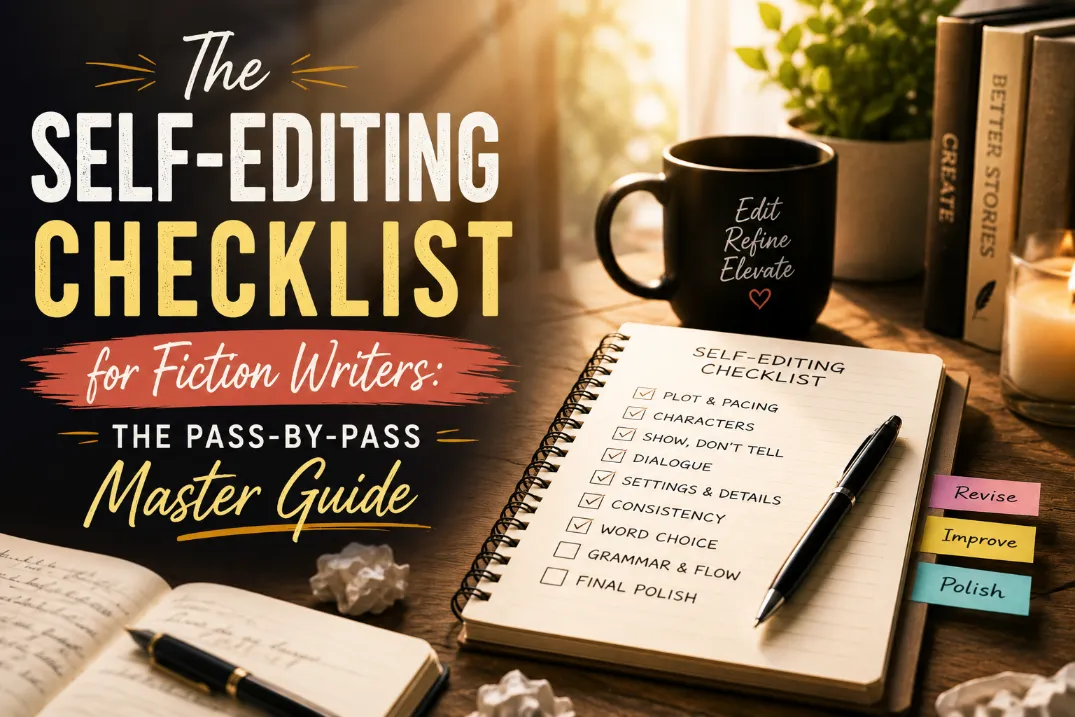
The Self-Editing Checklist for Fiction Writers: The Pass-by-Pass Master Guide

Expert Byline
Sushmith Reddy
Release Date
Last Updated
Let’s establish the most brutal reality of being an author right now.
Your first draft is garbage.
It is supposed to be garbage. The purpose of a first draft is simply to exist. It is you telling the story to yourself. It is a chaotic, messy block of marble.
The actual writing—the art that people pay money to read—happens in the edit. You are now transitioning from the frantic, emotional state of the "Creator" into the cold, ruthless, analytical state of the "Editor."
You cannot edit a book by starting on page one and fixing typos until you reach page three hundred. If you do that, you will spend two weeks perfecting the commas in a chapter that you will eventually have to delete anyway because it doesn't fit the plot.
You have to edit systematically. You have to start macro and move to micro.
Grab a coffee. We are going to look at the exact, five-phase, pass-by-pass self-editing framework that professional authors use to bulletproof their manuscripts before they ever pay a dime to a freelance editor.
Quick Navigation Map:
Phase 1: The Incubation Period (Do Nothing)
Before you change a single word, you must do the hardest thing in the world: absolutely nothing.
When you finish a draft, you are too close to it. Your brain has memorized the story. If you try to edit it immediately, your eyes will skip over massive plot holes and missing words because your brain automatically fills in the blanks with what you meant to write.
- The Rule: You must put the manuscript in a digital drawer and not look at it for a minimum of four weeks.
During this month, do not open the file. Read books in a completely different genre. Start outlining your next project. Binge a television show. You need to clear your mental cache.
When you finally open the document on week five, you will be shocked. You will read sentences and think, "Who wrote this garbage?"
Congratulations. You have achieved the objective distance required to actually edit your book.
Phase 2: The Story Pass (The Macro-Edit)
Do not touch your grammar. Ignore your typos.
The Story Pass is about the structural integrity of the house. You are looking at the massive steel beams. If the foundation is cracked, it doesn't matter what color you paint the walls.
1. The Reverse Outline
Read through your manuscript and create a spreadsheet. For every single chapter, write a one-sentence summary of what happens. Now, look at that spreadsheet.
- Is the pacing wildly off?
- Do you have six chapters in a row where characters just sit in a tavern talking, with zero action?
- Is the climax rushed into a single chapter?
2. The Character Arc Audit
Isolate your protagonist. Look at them in Chapter 1, and look at them in Chapter 30.
- Did they fundamentally change?
- Was that change earned through suffering and failure, or did they just magically figure it out?
- If they are the exact same person at the end of the book as they were at the beginning, your story is broken.
3. The Stakes Check
Why does the reader care?
- External Stakes: If the hero fails to defuse the bomb, the city explodes.
- Internal Stakes: If the hero defuses the bomb but has to sacrifice their partner to do it, their soul is destroyed. Are both of these stakes constantly present? Do they escalate? If the stakes drop in the middle of the book, you have hit the dreaded "mid-book slump."
4. The "Kill Your Darlings" Mandate
This is where you delete chapters. If a chapter is beautifully written, but it does not advance the plot, reveal a vital character secret, or raise the stakes... it has to go. Cut the 5,000-word flashback to their childhood. Cut the side-quest that goes nowhere.
Phase 3: The Scene Pass (The Micro-Structure)
You have fixed the overarching plot. Now, you need to zoom in and look at the individual rooms of the house. You are going to evaluate every single scene (usually demarcated by a line break or a new chapter).
1. The "Enter Late, Leave Early" Rule
Amateur writers start scenes with characters parking the car, walking up the driveway, knocking on the door, and exchanging pleasantries.
- The Fix: Cut the boring logistics. Start the scene the second the argument begins. End the scene the absolute second the dramatic question is answered. Don't write the awkward goodbye. Cut to black.
2. Scene vs. Sequel (Action vs. Reaction)
A perfectly paced book alternates between action and reaction.
- Scene (Action): The character has a goal, they face an obstacle, and it ends in a disaster. (e.g., They try to rob the bank, the alarm goes off, they barely escape).
- Sequel (Reaction): The character reacts to the disaster, processes their emotional state, and makes a decision on what to do next. (e.g., They hide in an alley, panic about the police, and decide they have to steal a car). If you have too many Action scenes in a row, the reader gets exhausted. If you have too many Reaction scenes, the reader gets bored.
3. The "Show, Don't Tell" Audit
Search your manuscript for emotion words: sad, angry, happy, nervous, terrified. If you wrote, "John was terrified," you are telling. You are feeding the reader raw data.
- The Fix: Delete the word. Replace it with physical, sensory evidence. "John's jaw locked. He wiped his sweating palms on his jeans for the fourth time and stared at the door." Make the reader feel the emotion through physical action.
Phase 4: The Line Pass (Voice, Flow, and Friction)
The plot is solid. The scenes are perfectly paced. Now, we finally look at the actual words. This pass is about the music of your writing. It is about removing the friction that trips up the reader's eye.
1. Eradicating Filter Words
Filter words are verbs that place an unnecessary barrier between the reader and the action. They remind the reader that they are reading a book.
- Examples: I saw, I heard, I felt, I noticed, I realized, I watched.
- Bad (Filtered): I heard the glass shatter in the kitchen, and I felt my heart race.
- Good (Direct): Glass shattered in the kitchen. My heart raced. Use the "Find" function in Word and delete 90% of your filter words.
2. The Crutch Word Purge
Every writer has words they unconsciously rely on when they are drafting. They clutter the prose and dilute the impact of your sentences. Do a global search for these exact words and delete as many as humanly possible:
- Just
- Really
- Very
- Suddenly
- That (e.g., "He knew that she was lying" -> "He knew she was lying").
- Nodded / Sighed / Shrugged (We often use these when we don't know what else a character should do. Limit them).
3. The Dialogue Tag Cleanup
"Said" is invisible. The reader's eye glides right over it. Amateurs try to spice up their dialogue tags by writing:
- "I hate you!" she vociferated.
- "Let's go," he ejaculated.
- "I'm tired," she sighed. (You cannot physically sigh a word).
- The Fix: Stick to "said" and "asked." Better yet, use action beats instead of tags. "I hate you." She slammed the coffee mug onto the table.
4. Sentence Length Variation (The Gary Provost Rule)
If all your sentences are the same length, your writing becomes a monotonous drone. The reader will literally fall asleep. You must vary your sentence length to create rhythm. Write short sentences for action. For punchy, brutal moments. Write long, flowing, complex sentences to slow the reader down, to mimic the lazy heat of a summer afternoon or the deep, winding contemplation of a character in mourning. Read your chapters out loud. If you run out of breath, or if you sound like a robot, fix the rhythm.
Phase 5: The Copy Pass (The Final Polish)
This is the final coat of paint. You have done all the heavy lifting. Now you are hunting for the tiny, microscopic errors that make a manuscript look unprofessional to a literary agent or an editor.
1. Technology is Your Friend
Do not rely on your own eyes for this. You will miss things. Run your manuscript through ProWritingAid or Grammarly Premium. These tools will catch missing commas, passive voice abuse, and accidental double spaces. (However, do not blindly accept every suggestion. They are robots; you are the artist. If a fragmented sentence serves the artistic tone of the scene, keep it).
2. The Consistency Check
Keep a "Story Bible" document open.
- Did the main character's eyes change from blue to green in Chapter 14?
- Did they drive to the location in a Ford, but leave in a Chevy?
- Did it take them three days to travel a distance that took three hours earlier in the book? Ensure your timeline and physical descriptions are ironclad.
3. Standard Manuscript Format
If you are sending this to a professional editor or a literary agent, you must format it to industry standards. If you send them a document in 10pt Comic Sans with zero margins, they will delete it immediately.
- Font: 12pt Times New Roman.
- Spacing: Double-spaced.
- Indentation: First line of every paragraph indented by 0.5 inches (Do not use the Tab key; set it in the paragraph formatting rules).
- Margins: 1-inch margins on all sides.
The Bottom Line
Self-editing is exhausting. It is often significantly harder than writing the first draft. It forces you to confront your own flaws, your bad habits, and your lazy plotting.
But it is the most vital skill you will ever learn as an author.
When you run your manuscript through these five passes, you transform it from a chaotic mess into a tightly engineered, professional product.
When you finally hand this polished manuscript over to a professional freelance editor, you won't have to pay them to tell you that Chapter 4 is boring. They will be able to focus on the high-level nuances of your voice, elevating a good book into an unputdownable book.
Respect your own art. Put in the work. Edit ruthlessly.