
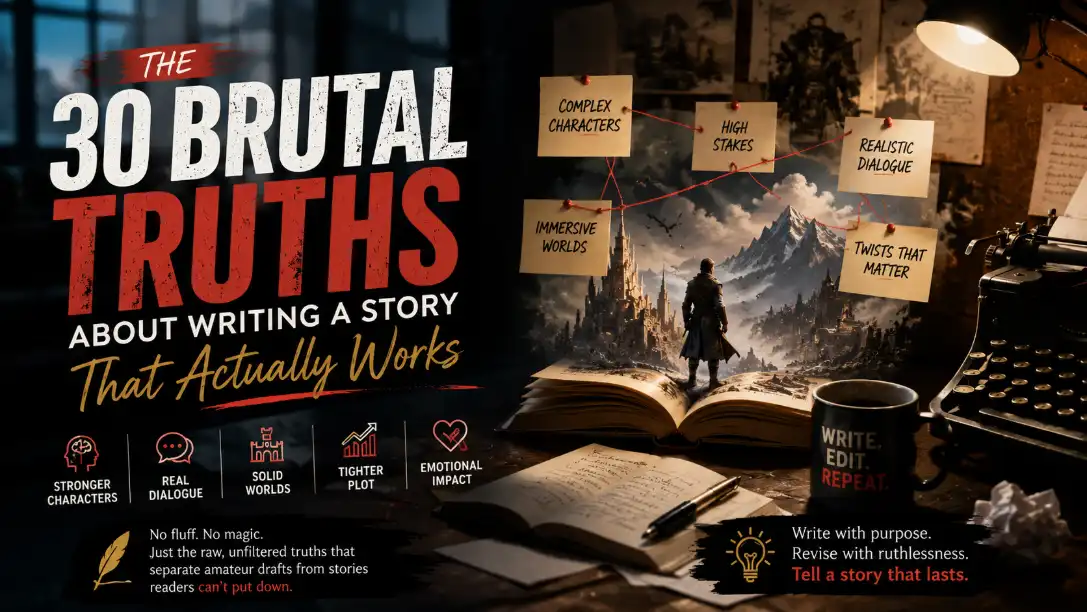
The 30 Brutal Truths About Writing a Story That Actually Works

Expert Byline
Sushmith Reddy
Release Date
July 12, 2026
I’ve spent years tearing apart rough drafts, trying to figure out why a story falls flat the second a reader actually tries to engage with it. And honestly? Writing a great book isn't about waiting for inspiration to strike while you stare out a rainy window.
A lot of people think creative writing is magic. It’s not. It’s a craft. If your core plot is a mess, or your character motivations are weak, the whole thing falls apart by chapter three.
I want to strip away the artsy fluff. Let's grab a coffee and look at the actual, non-negotiable rules that separate amateur drafts from stories that keep people up reading until 4 AM.
Here is how we fix a broken story, broken down by the core elements of fiction writing.
Quick Navigation Map:
Phase 1: Building Real People (Character Development)

1. The Flawed Hero Rule
If you make every character flawless, your story is dead on arrival. Perfection gives the reader absolutely nothing to connect with.
To make a character feel like a breathing human, you have to give them a solid foundation. Give them at least one glaring flaw, one secret weakness, one weird strength, one normal hobby, a short-term want, and a massive long-term goal.
- The Problem: Flaws create conflict. A flaw is internal (like crippling arrogance). A weakness is external (a bad knee, or a soft spot for their toxic ex).
- The Fix: Meet Detective Sarah Vance. She’s deeply cynical and addicted to sleep aids. But she is brilliant at reading crime scenes and spends her weekends restoring vintage radios. Her short-term want is to close a missing-persons case by Friday, but her real goal is to catch the serial killer who ruined her mentor's life. Now you have a real person, not a cardboard cutout.
2. The Villain's Justification
A bad guy who wants to blow up the world just because he's "evil" is a boring cartoon. Your antagonist has to be the hero of their own twisted story.
- The Problem: The best tension happens when the reader looks at the villain and thinks, "I hate what this guy is doing, but his reason for doing it actually makes sense."
- The Fix: Your rebel leader isn't taking down the power grid for ransom money. He's doing it because the grid is run by a corrupt government secretly tracking citizens. He thinks blacking out the city is the only way to save their freedom.
3. Drivers, Not Passengers
Your main character has to actually drive the plot. If things just happen to them and they just react without making hard, active choices, the reader will get bored and leave.
- The Problem: Choice is everything. They have to push the buttons. Even if they press the wrong button and make things worse, their active choice needs to push the story forward.
- The Fix: Asteroid heading to Earth? Don't make your hero a guy just watching the news in horror. Make him a disgraced pilot who hijacks a shuttle because he knows the military's plan will fail.
4. The Phantom Wound
Every great character has a bleeding wound from their past. A trauma, a huge failure, or a bitter betrayal that dictates how they act today.
- The Problem: Unmotivated characters are boring to read. We are all shaped by our past pain.
- The Fix: A defense attorney refuses to represent big corporations because, early in her career, she won a case for a chemical company—only to find out later they were actually poisoning the local water supply. The guilt runs her entire life.
5. The Walking Warning Sign
Give your main character a mirror character—someone with similar skills or a similar background who made the wrong choices in life.
- The Problem: It gives the reader a walking, talking warning sign of what the hero will become if they fail to grow and change.
- The Fix: An idealistic young politician goes up against a ruthless, corrupt mayor who started out with the exact same ideals thirty years ago.
6. Background Characters Have Lives Too
If your secondary characters just sit around waiting to tell the hero how great they are, your world feels fake.
- The Problem: A real world has friction. Side characters need their own personal goals that occasionally get in the way of the hero's plans.
- The Fix: The loyal sidekick shouldn't just be there to help. Give him a sick mother and a secret offer from the bad guys to pay her medical bills. Now you have a volatile element in your story.
Phase 2: What They Say & What They Hide (Dialogue & Subtext)
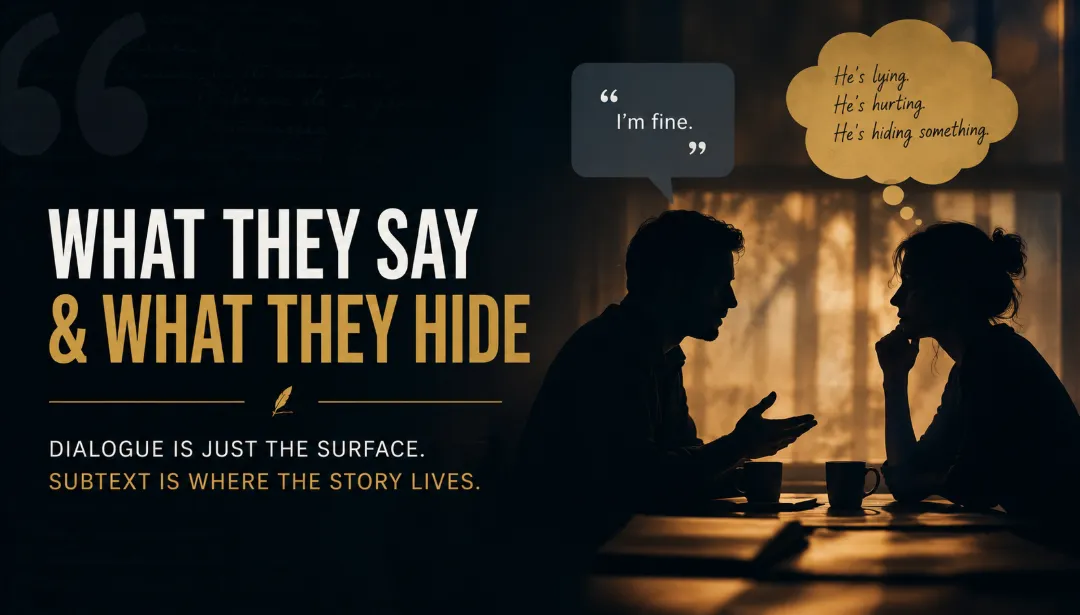
7. People Don't Say What They Mean
Dialogue isn't just about sharing information. People rarely say exactly what's on their mind. It’s all subtext, power plays, defense mechanisms, and hidden emotions.
- The Problem: If Character A asks, "Are you mad at me?" and Character B says, "Yes, I am mad because you forgot my birthday," I am closing the book. That is not how humans talk.
- The Fix:
- A: "Are you mad at me?"
- B: (Scrubbing a plate that’s already clean) "The kitchen clock is slow. We’re going to hit traffic." You feel the anger without anyone ever saying the word "mad."
8. The Iceberg Rule
The words spoken out loud are just the tip of the iceberg. The remaining 90% is all the history, grudges, and hidden agendas churning underneath the conversation.
- The Problem: Readers want to feel smart. Let them decode the tension themselves.
- The Fix: Two business partners are arguing about splitting a lunch bill. But underneath, one knows the other is stealing money from the company. Suddenly, "you're taking more than your fair share" isn't about the lunch anymore.
9. The Blindfold Test
If I delete every "he said" and "she said," I should still know exactly who is talking just by their rhythm, slang, and sentence length.
- The Problem: If everyone sounds exactly like the author, your world falls flat.
- The Fix: The professor says, "The statistical probability of structural failure is extremely high." The street kid says, "Roof's coming down. Move." Same information, completely different voices.
Phase 3: The Rules of the Realm (Worldbuilding & Logic)
10. Infinite Power is Boring
Whether you're writing hard sci-fi or a high-fantasy magic system, your world needs limits. If your characters have infinite power with zero consequences, you just deleted all the tension.
- The Problem: Suspense doesn't come from what a tool or magic spell can do. It comes from what it can't do, and what it costs the user.
- The Fix: A wizard shouldn't be able to just throw fireballs all day. Make the magic pull heat directly from their own body. Casting a massive spell drops their core temperature. Now, every fight is a gamble with hypothermia.
11. Hide the Foundation
Worldbuilding is like the foundation of a house. It has to be there to keep the walls up, but you shouldn't force your guests to go to the basement to stare at the concrete.
- The Problem: Stopping the plot to deliver a heavy history lecture kills your pacing.
- The Fix: Don't tell me the city is flooded and poor. Tell me the main character has to scrape toxic green mold off his boots every morning before going to his miserable minimum-wage job.
12. Never Break Your Own Rules
Establish your rules early, and never break them just because you wrote yourself into a corner and need an easy way out.
- The Problem: The second a reader spots a logical flaw, their trust in you is shattered.
- The Fix: If your magic telepaths can only read minds by physically touching someone, your hero cannot magically read the sniper's mind from across a stadium just to save the day. Find a real, logical way out of the danger.
Phase 4: Keeping Them Awake (Story Pacing & Tension)
13. Stop Explaining Everything on Page One
Please, for the love of reading, stop dumping your world's history in the very first chapter. Nobody cares about the 300-year history of your fictional empire when they don't even know the main character's name yet.
- The Problem: Readers aren't looking for a Wikipedia article. Drop them right into the action. Drip-feed the background context only when they absolutely need it to understand what is happening.
- The Fix: Don't start a sci-fi book with, "The Mars colony was founded after the Great Wars." Start with, "Kaelen’s oxygen mask hissed, giving him exactly four minutes of air." As he scrambles to survive, we naturally figure out why the air is toxic.
14. Compound the Debt
You can't start your story at a level-ten panic. If the threat is "the world is ending" on page one, you have nowhere to go but down. Stakes have to grow slowly.
- The Problem: You have to hook the reader with something personal first, then let the danger expand.
- The Fix: She just wants to win a cooking competition to save her family's diner. Then she finds out the rival chef is using illegal ingredients. Then she realizes a massive corrupt company is using the contest to test dangerous chemicals on the judges. Diner to public health hazard. Perfect escalation.
15. The Heartbeat Rule
Pacing is a heartbeat. You need massive spikes of tension, followed by necessary periods of rest. If the whole book is just explosions, it’s exhausting. If it's all talking, it's boring.
- The Problem: The quiet, emotional moments are what give the loud action scenes their impact.
- The Fix: Just had a crazy 15-page car chase? Put them in a dingy motel room to patch their wounds and argue about whose fault it was. Let them breathe and process their fear before the bad guys show up again.
16. Justify Page One
You have to justify why the story is starting today. Why are we opening the book right now instead of three weeks ago?
- The Problem: If you open on a totally normal Tuesday where nothing happens, there's no urgency. You need an interruption to their normal life immediately.
- The Fix: Skip the part where the detective eats breakfast and feeds the cat. Start with the 3:00 AM phone call from a dead man.
17. The Rule of Three
Human brains love the rule of three. Try, fail. Try again, make it worse. Try a third time, succeed by the skin of your teeth.
- The Problem: One attempt is too easy. Two feels like a coincidence. Three builds a perfect ramp of tension.
- The Fix: Picking a locked door. Attempt 1 breaks the lockpick. Attempt 2 triggers a silent alarm. Attempt 3—with guards running down the hall—they kick the door off its hinges just in time.
18. Ruin Their Sleep Schedule
Never end a chapter on a clean, happy note. End on an unanswered question, a sudden shock, or a shift in the wind.
- The Problem: You want them to say, "Just one more chapter" at 2 AM.
- The Fix: Don't end with them going to sleep safe in the hotel. End with them turning off the light, only to hear a soft knock at the window.
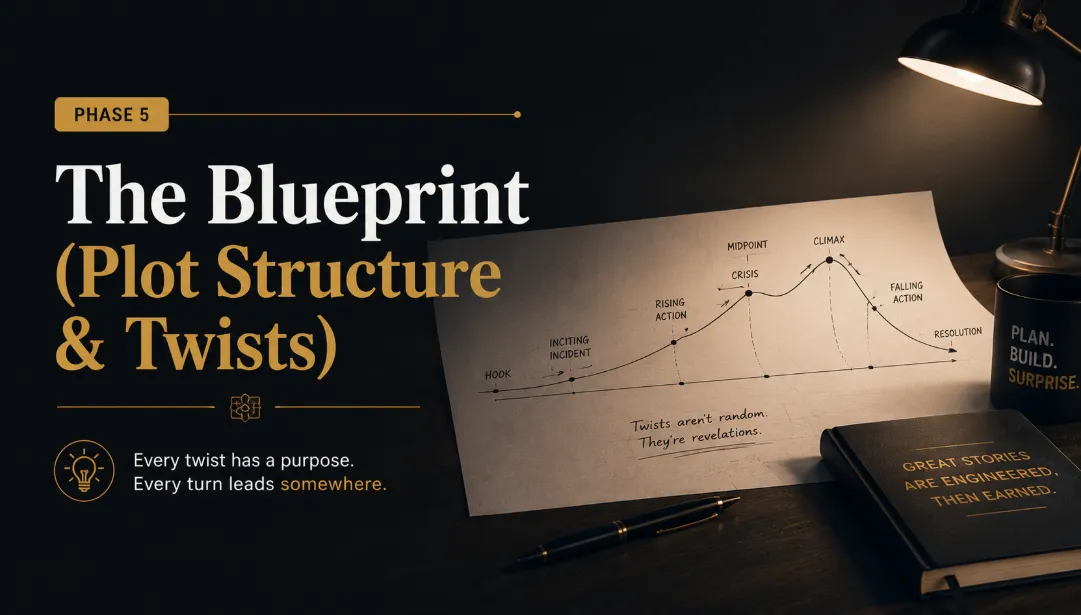
Phase 5: The Blueprint (Plot Structure & Twists)
19. Coincidence Can Break Things, Not Fix Them
You can use a totally random coincidence to throw your characters into terrible danger. But the second you use random good luck to pull them out of it? You just cheated your reader.
- The Problem: Bad luck feels like real life—unfair and unpredictable. Good luck feels like a lazy writer who didn't know how to end the scene properly.
- The Fix: A stray dog stealing a guy's passport right before a flight is a great coincidence that kicks off a bad day. Lightning striking the bad guy just as he's about to shoot your hero is terrible writing.
20. The Loaded Gun (Chekhov's Gun)
If you spend time pointing out a specific object, skill, or weird fact early on, it absolutely has to matter later in the story.
- The Problem: If you set up a clue and never use it, you break the reader's trust. Unused details are just clutter.
- The Fix: If you spend half a paragraph describing a heavy brass paperweight on a desk in chapter two, someone better grab it during a fight by chapter ten. If not, delete the description.
21. Burn the Bridge
At the end of your first act, your hero has to cross a line they can't uncross. Returning to their comfortable, safe old life has to become impossible.
- The Problem: If things get hard and your character can just say, "Forget this, I'm going home," your plot loses all its momentum.
- The Fix: Your witness didn't just agree to help the police. The local gang found out he was talking and burned down his apartment. Going back isn't an option. The only way out is through.
22. Twists Should Hurt, Not Cheat
A cheap plot twist relies on you hiding obvious facts from the reader. A great twist shocks them, but makes them realize the clues were staring them in the face the whole time.
- The Problem: A good twist makes the reader want to re-read the book immediately to see how they missed it.
- The Fix: The loyal assistant is the traitor. Don't just make them suddenly act evil at the end. Make the reader realize that every time a plan failed, the assistant was the one scheduling the meeting or handling the maps. They were always there.
23. Plant Clues Like Background Noise
Foreshadowing shouldn't look like a neon sign. It should look like background chatter that only makes sense later.
- The Problem: It prepares the reader's subconscious so the big reveal feels earned, not random.
- The Fix: A guy complains about a mild buzzing in his ear from a loud concert. Two hundred pages later, we find out he's got a tracking device hidden in his jaw.
24. Tie Up Your Loose Threads
Don't let your subplots wander off and die. Every side-quest, minor character, or romance has to eventually crash into the main plotline.
- The Problem: If a subplot doesn't impact the ending of the book, you just wasted the reader's time.
- The Fix: The hero is trying to stop a corrupt mayor (main plot) and is going through a nasty divorce (subplot). The ex-wife's lawyer accidentally uncovers hidden bank accounts during the divorce that gives the hero the exact evidence needed to arrest the mayor.
25. The Midpoint Flip
Right at the middle of the book, the whole dynamic needs to shift. The hero stops running away and starts going on the offensive.
- The Problem: Watching someone run away for 300 pages is tiring. You have to flip the power dynamic.
- The Fix: A heist crew is scrambling to dodge security for the first half. Midpoint: they realize the bank owner is going to double-cross them. Instead of running, they flip the script and decide to steal his personal escape helicopter.
26. Make Them Pay the Toll
A victory without a sacrifice feels incredibly cheap. If they beat the bad guy and lose absolutely nothing, it’s a hollow win.
- The Problem: A satisfying ending requires payment. Big goals require big sacrifices.
- The Fix: They save the kingdom, but they have to use up all their own magic to do it. They live, but they’ll be a normal, powerless human for the rest of their life. That hurts. That sticks with the reader.
27. Make the Final Battle Personal
The climax can't just be a fistfight or an explosion. The external battle has to force the character to face their internal flaw (from Law 1).
- The Problem: The character's emotional journey and the plot's action have to lock together at the very end.
- The Fix: A climber whose fatal flaw is stubborn pride has to save his team. At the very end, he physically cannot pull his friend up alone. He has to swallow his ego and beg for help from a rival.
28. The Hidden Argument
Theme isn't a preachy moral at the end of a fable. It’s the core argument running underneath the whole book.
- The Problem: A story without a theme is just a bunch of random events happening in order.
- The Fix: If your theme is "Security vs. Freedom," make one character a strict cop, one a wild rebel, and put your hero in the middle trying to figure out who is right.
29. The Echo Ending
Your final scene should reflect your opening scene, but show the massive transformation the character went through.
- The Problem: It gives structural closure and proves the journey actually mattered.
- The Fix: Opening: A lonely kid trying to fix a broken radio to hear a voice. Closing: An old man turning off a perfectly working radio so he can go sit in silence with his family.
Phase 6: The Final Polish (Editing & Refining)
30. Ruthlessly Delete Pretty Words
In writing, we call this "killing your darlings." You have to be willing to throw out pages of beautiful writing if it doesn't serve the story's core purpose.
- The Problem: If a scene doesn't move the plot forward or reveal something new about the character, it’s just author ego.
- The Fix: You wrote a stunning 2,000-word chapter about a walk in the woods with incredible metaphors. But the character learns nothing new and the plot stops moving. Delete the chapter. Keep one pretty sentence. Move on.