
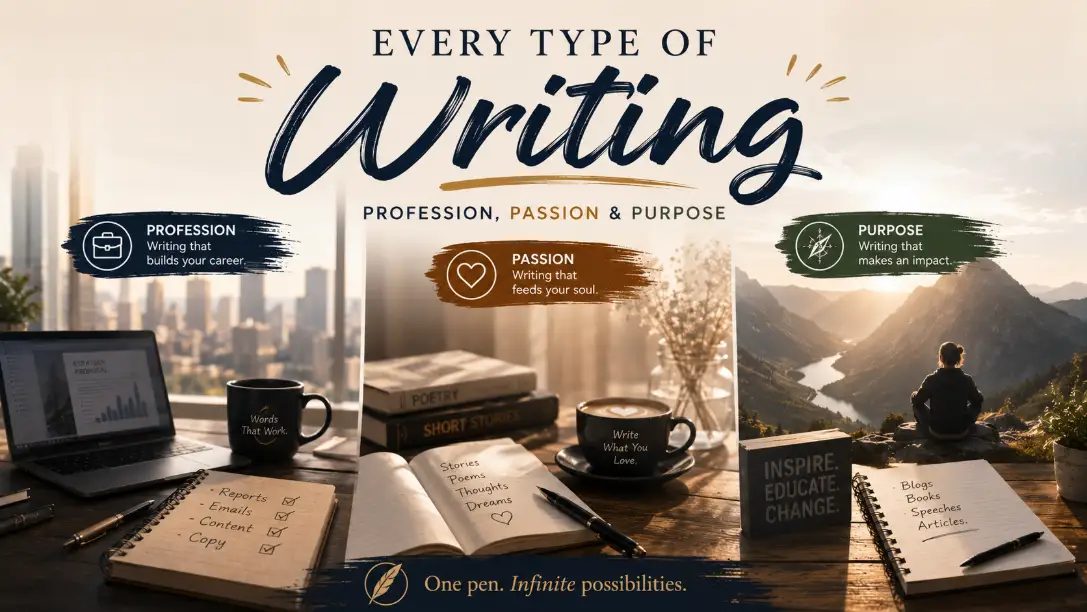
Every Type of Writing (Profession, Passion & Purpose)

Expert Byline
Sushmith Reddy
Release Date
July 24, 2026
Let’s be honest. When you Google "types of writing," you usually get handed a dusty textbook list from a middle school English class. They tell you about "expository discourse" and act like writing is just something you do to pass a standardized test.
That isn't how the real world works.
Yes, there are four core academic pillars of writing. But out here in the wild? Writing is the engine of the entire modern world. It is how billion-dollar companies sell products, how heartbroken people heal, and how massive online communities connect.
If you are trying to figure out what kind of writing you want to do, you don't need a dictionary definition. You need to know the difference between writing for a paycheck, writing for your soul, and writing just to stay sane.
Grab a coffee. We are going to tear down the traditional definitions and look at every single real-world type of writing, categorized by how you actually use it: for your profession, your passion, or your everyday life.
Quick Navigation Map:
The 4 Academic Pillars
Before we look at the specific jobs and hobbies, you need to understand the engine that powers them. Every piece of text on earth—from a Super Bowl commercial to a diary entry—is built on one of these four foundational styles.
- Expository Writing: The Informer. This is raw information transfer. No bias, no emotion. Just the facts. (Think: Wikipedia, instruction manuals, news reports).
- Persuasive Writing: The Closer. The goal is to change the reader's mind or make them take action. (Think: Sales pages, political speeches, cover letters).
- Narrative Writing: The Storyteller. This is the art of building characters, conflict, and a plot arc. (Think: Novels, screenplays, memoirs).
- Descriptive Writing: The Painter. Using the five senses to paint a highly vivid picture in the reader's mind. (Think: Poetry, travel journals).
Now that you know the tools, let’s look at how we actually use them in the real world.
Types of Writing by Profession (The Money-Makers)
If you want to turn words into a reliable paycheck, this is your neighborhood. Professional writing is rarely about waiting for "inspiration." It is about solving specific problems for businesses and readers on a tight deadline.
1. Copywriting (The Sales Engine)
Copywriting is the art of writing words that make people take an immediate action. Usually, that action involves pulling out a credit card or clicking a "Subscribe" button.
- The Reality: You aren't trying to sound poetic. You are using human psychology to highlight a pain point and position a product as the cure.
- Examples: Facebook ads, landing pages, email sales funnels, billboard slogans.
- Core Pillar Used: Persuasive.
2. Content Writing & SEO (The Trust Builder)
While a copywriter asks for the sale, a content writer builds the relationship. Content writing is designed to educate an audience, provide free value, and rank high on Google using Search Engine Optimization (SEO).
- The Reality: This is the backbone of internet marketing. You take complex industry knowledge and make it incredibly easy for a normal person to read and understand.
- Examples: Blog posts (like this one), white papers, case studies, YouTube scripts.
- Core Pillar Used: Expository & Persuasive.
3. Technical Writing (The Translator)
Technical writers take wildly complicated, jargon-heavy information from engineers or developers and translate it into plain English for the end user.
- The Reality: It isn't glamorous, but it pays incredibly well. If you love logical systems, formatting, and absolute clarity, this is a highly stable career.
- Examples: Software documentation, medical manuals, API guides, standard operating procedures (SOPs).
- Core Pillar Used: Expository.
4. UX Writing (The Digital Guide)
UX (User Experience) writing focuses on the "microcopy" inside apps and websites. The goal is to help a user navigate a digital product without getting confused or frustrated.
- The Reality: You will literally agonize for an hour over whether an error message should say "Try Again" or "Refresh Page." It requires extreme empathy and brevity.
- Examples: App navigation menus, error messages, checkout buttons, onboarding screens.
- Core Pillar Used: Expository.
5. Journalism (The Investigator)
Journalists report on real-world events, trends, and people. Their ultimate loyalty is to the truth and the reader, not the subject they are interviewing.
- The Reality: It’s fast-paced, deadline-driven, and requires you to have a thick skin to hunt down reluctant sources.
- Examples: Newspaper features, investigative reports, magazine profiles.
- Core Pillar Used: Expository & Narrative.
Types of Writing by Passion (The Art & Soul)
This category is for the world-builders. If you want to explore the human condition, play God with imaginary universes, or share your own deepest truths, you belong here. The money is less predictable, but the creative freedom is absolute.
6. Creative Fiction (The World Builder)
This is the invention of completely fabricated stories. You are responsible for pacing, character arcs, dialogue, and world-building.
- The Reality: It is a marathon. Writing a novel requires massive self-discipline. You will spend months alone in a room wrestling with people who do not exist.
- Examples: Novels, short stories, fantasy epics, thriller mysteries.
- Core Pillar Used: Narrative & Descriptive.
7. Screenwriting & Playwriting (The Architect)
You are writing the blueprint for visual media. A script isn't meant to be read like a book; it is a set of technical instructions for actors, directors, and lighting crews.
- The Reality: You have to think entirely in pictures. You must master the art of subtext (where characters don't say exactly what they mean) and leave your ego at the door, because a director will change your words.
- Examples: Movie scripts, TV pilots, stage plays, video game narratives.
- Core Pillar Used: Narrative.
8. Memoir & Personal Narrative (The Time Traveler)
You are writing true stories from your own life. But unlike a boring autobiography (which just lists your life events in order), a memoir extracts a specific theme or lesson from your past to help the reader.
- The Reality: It requires brutal vulnerability. You have to be willing to look at your own mistakes and flaws with the cold, objective eye of a seasoned editor.
- Examples: Book-length memoirs, personal essays, narrative nonfiction.
- Core Pillar Used: Narrative & Descriptive.
9. Poetry (The Emotion Distiller)
Poetry strips language down to its absolute most potent form. It relies heavily on rhythm, metaphor, and emotional resonance rather than a standard plot.
- The Reality: It is the ultimate exercise in word economy. Every single syllable has to carry weight.
- Examples: Sonnets, free verse, spoken word, haikus.
- Core Pillar Used: Descriptive.
Types of Writing by Hobby & Community (The Connectors)
Not everything has to be optimized for a search engine or sold to a publisher. Sometimes, writing is just the way we process our day or find people who love the exact same weird things we do.
10. Lifestyle Blogging & Newsletters
This is writing as community building. You are sharing your hobbies, your daily routines, or your unique perspective with an audience that tunes in specifically for your voice.
- The Reality: Platforms like Substack and Medium have made it easier than ever to build a massive following just by writing consistently about something you genuinely love.
- Examples: Travel blogs, recipe writing, weekly email newsletters, fashion journals.
- Core Pillar Used: Expository & Narrative.
11. Fanfiction (The Sandbox)
Fanfiction writers take existing characters and universes from popular media (like Harry Potter, Marvel, or Star Wars) and write their own original stories within those worlds.
- The Reality: It gets a bad rap from literary snobs, but it is one of the most vibrant, supportive writing communities on the planet. It is an incredible way to practice pacing and dialogue without having to invent a world from scratch.
- Examples: Alternate Universe (AU) stories, "shipping" narratives, expanded lore.
- Core Pillar Used: Narrative.
12. Journaling & Free-Writing (The Mental Reset)
Writing purely for an audience of one: yourself.
- The Reality: You ignore grammar. You ignore structure. You use the page as a dumping ground for anxiety, ideas, and daily reflections. It is cheaper than therapy and clears the mental cache so you can actually focus.
- Examples: Morning pages, bullet journaling, gratitude logs, dream diaries.
- Core Pillar Used: Freeform.
How to Choose Your Writing Path
Looking at a dozen different types of writing can feel overwhelming. But here is the secret most pros won't tell you: You don't have to pick just one.
The modern writing landscape rewards hybrids. I know technical writers who draft software manuals by day and write horror novels by night. I know highly-paid copywriters who run free poetry blogs on the weekends.
To figure out where to start right now, ask yourself one brutal question: What do I need from my writing today?
- If you need immediate income, start studying copywriting or SEO content writing.
- If you need to process a trauma or a specific memory, open a blank document and start a personal narrative.
- If you just want to have fun and find a community, start a niche newsletter or try your hand at fanfiction.
Stop worrying about what kind of writer you are supposed to be. The world doesn't care about your title. It only cares about the words you put on the page. Pick a lane, sit down at the keyboard, and get to work.